Monday, February 26, 2007

Lost and Safe

Work by Michael Samuels

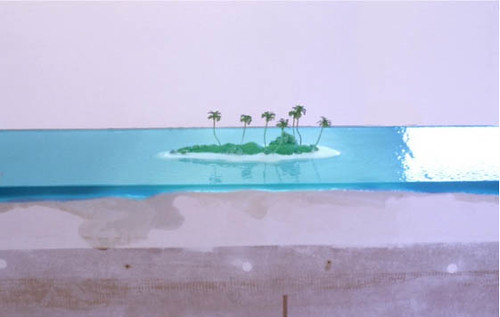
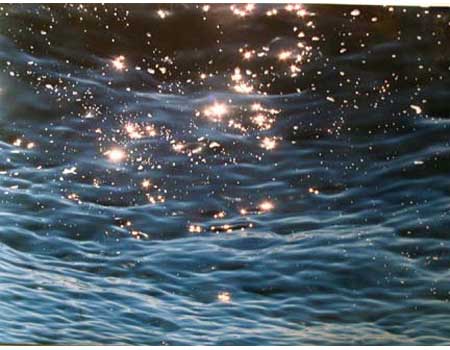
Rescue Me, 2005. from his exhibition at the rokeby gallery

"Samuels’ hyper-real model environments offer us miniature utopias. These are places which promise a blissful escape, lulling us into reverie. However, these idealised desert islands offer a double-edged paradise... "

Remote and remove. 2006, Resin and mix media

120x60x120 cm

"On first site his enticing seascapes appear to present an idealized paradise, empty and quiet, tranquil and submissive the scenes appear to be ones set out for escapist pleasure though on closer inspection the rocky land masses actually suggest a darker and more mysterious world; "

Save What you Can, 2005

"The seductive blue sea’s made up of layers of resin are initially gratifying yet Samuels is careful to leave the side of his worlds, which he presents on workbenches, raw; immediately the veneer of the sea jars with the reality of the materials and the commonplace apparatus from which they were conjured. Man’s quest for paradise is one for something unobtainable and contrived. "

Left for dead. 2002. Resin and mix media

60x20x120 cm

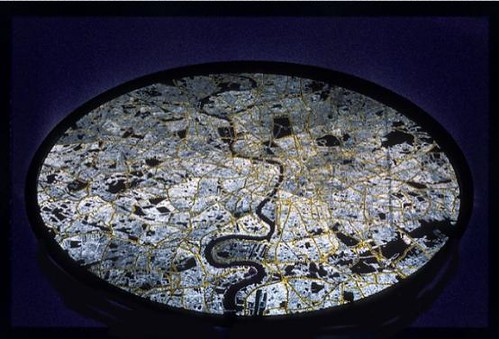
Microscope. 2002. map, Pinpricks, lightbox, 80x80 cm
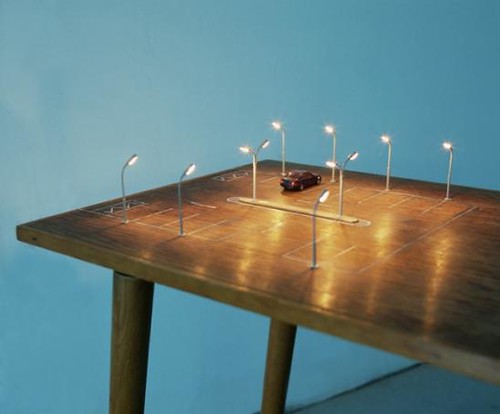
Bad Moon. 2003. table and electronics. 70x50x40 cm

via new blog of artist nathan abels - who's art is also to be viewed

got reminded of Island, one of the most beautiful/sad song that i know of King Crimson.

Lyrics by King Crimson (Fripp/Sinfield)

Earth, stream and tree encircled by sea

Waves sweep the sand from my island.

My sunsets fade.

Field and glade wait only for rain

Grain after grain love erodes my

High weathered walls which fend off the tide

Cradle the wind

to my island.

Gaunt granite climbs where gulls wheel and glide

Mournfully glide o'er my island.

My dawn bride's veil, damp and pale,

Dissolves in the sun.

Love's web is spun - cats prowl, mice run

Wreathe snatch-hand briars where owls know my eyes

Violet skies

Touch my island,

Touch me.

Beneath the wind turned wave

Infinite peace

Islands join hands

'Neathe heaven's sea.

Dark harbour quays like fingers of stone

Hungrily reach from my island.

Clutch sailor's words - pearls and gourds

Are strewn on my shore.

Equal in love, bound in circles.

Earth, stream and tree return to the sea

Waves sweep sand from my island,

from me.

youtube listen

Sunday, February 25, 2007

Remembering Delhi

As this wave from memories flows in, the city soaks it up like a sponge and expands.

Italo Calvino, Invisible Cities

A Chrono-topo-graphy of Imagination

Subhash Jaireth, a poet, born in india, describe his coming back to visit india after many years he was apsant (in order to meet his daughter, whom he didn't see for 5 years)- he is walking through the streets of Delhi, accompanied by maps and aided with histories both personal and formal, Jaireth revisits the city as an imaginative construct, an interplay of concrete and abstraction.

Delhi as it looked just before the Rebellion of 1857: CLICK FOR A LARGE SCAN . and more Delhi maps

"..in the anticipated journey to Delhi to see my daughter. That journey opened the way for the trips which I have taken to the Delhi of my childhood and youth, and also to that Delhi which I have imagined by reading, seeing, and listening to all that surrounds Delhi like a Benjamian "aura." As I write/walk each word/step takes me through the city of my memories.."

The Fatehpuri Masjid of Delhi 1840's

"In the past, first as a school boy and later as an academic, I had never felt the need of a map. The city always seemed familiar and homely. Often it felt like a big town, too chaotic to be contained within the limits of a map. On the Lonely Planet map, Delhi looks like a city. It has a shape, a structure, rationality defined by a neat pattern of straight roads, roundabouts, and green patches of boulevards, parks and gardens. The meandering blue outlines of the river Yamuna, painted along the eastern margin of the map, makes the city picturesque."
Bicycle rikshaw driver taking children home after school. New Delhi. via

"...Walking is one of those spatial practices through which people transform places into spaces by making them "their own" and by circumscribing them within their everyday living. "Walking," notes Michel de Certeau, "is to the urban system what the speech act is to language. Walking affirms, suspects, tries out, transgresses...it speaks." For de Certeau walking is equivalent to reading which produces a space by transforming a written text, "the place constituted by a system of signs." A similar thing has happened, and is happening now, as I write this essay, although instead of reading, I am engaged in the acts of remembering and writing. But as I write, I read the traces of my own walks. I write them for you and for myself. I have thus created a map for you to read and walk and transcribe your presence over the traces which I have left. As you read and walk through my Delhi, you traverse the mind scape of my memories. "

"..Maps, like stories, de-scribe and in-scribe places. Through them places are assimilated, owned and disowned, longed for and belonged to. In fact, stories, to use de Certeau's words, often simultaneously employ "map type" (at the western end of the Chandni Chowk) and "tour type" (you walk along the Chandni Chowk and turn right at the first intersection) descriptions. For de Certeau they represent two symbolic and anthropological languages of space. If map type descriptions present a tableau and focus on seeing, tour type tend to organise movements and focus on operations, actions, and itineraries. In stories, the two types intervene and punctuate each other's presence, conditioning as well as preparing ground for each other. "

Read On

he also mention the book 'INDIAN MAPS AND PLANS' : Susan Gole, 1989, New Delhi. that seems very interesting, i could only find one sample from her book. as well as 'The Delhi Book' by writen by Sir Thomas Metcalfe that while working in India as the Governor-General's Agent at the Imperial court of the Mughal Emperor, assembled an album containing 120 paintings by Indian artists. He wrote his own descriptive text alongside these paintings, and sent the precious 'Delhi Book' to his children in England.

The Resident Sir Thomas Metcalfe and his assistants taking part in the Mughal Emperor's procession to celebrate the 'Id festival. Metcalfe is the man seated on the red chair at the front. This detail shows merely one of the twelve panels that make up this painting.

Saturday, February 24, 2007

Jananne Al-Ani

Iraqi/Irish artist JANANNE AL-ANI

Untitled; Portrait, 1996 (1 of 5) DoubleDuratrans 25 x 20 cm

digital landscape

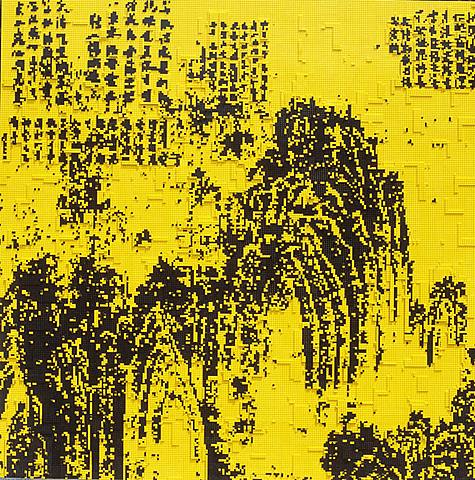
Inkie Whang, Lego on plywood, 205.7 x 205.7 cm, 2004 While trained as a painter, Whang In-Kie terms his most recent work “digital landscape,” in which traditional literati paintings are reinterpreted through modern means. The works are scanned and then reformulated into an accumulation of thousands of acrylic and silicon pieces. The resulting mosaic-like compositions resonate with viewers accustomed to a visual lexicon of digitized imagery, divergent social and historical sources, and cultural hybridity.

Takes Two

naked tango by Guillermo Kuitca. and this time followed by PDB on tango and some listening of Gotan Project music

1994 acrylic on canvas 76 7/8 x 58 3/8 inches195 x 148 cm Private Collection

Tree Drawings/Arboretum

Musician david byrne's drawing/diagrams (mostly) in the form of trees, which both elucidate and obsfucate the roots of contemporary phenomena and terminology. Sort of like borrowing the evolutionary tree format and applying it to other, often incompatible, things. In doing so a kind of humorous disjointed scientism of the mind heaves into view.

Alternate Universes, 2002 Published by McSweeney's as Arboretum in 2006

Friday, February 23, 2007

Beirut

series by artist Xavier Deshouli

Green Line (Beirut). 2006 • • 81 cm X 102 cm Oil on Canvas

Thursday, February 22, 2007

COMING

by Guillermo Kuitca, {one of my favorite living artists}

Guillermo Kuitca Coming, 1988 acrylic on canvas . 140 x 100 cm

Wednesday, February 21, 2007

Dust, Breath and Varnish on Glass

each of these works by artist Markus Hansen, is unique and there is only one edition of each image.

2004 • Dust, breath and varnish on glass

from the explanation about this strange title and method of creation:

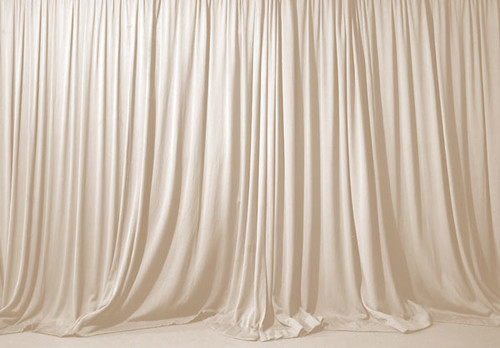
"My studio was always covered with dust and when I moved things it left traces. It was the perfect compliment to the chromed hygiene pieces. I began controlling the marks left by the dust using stamps and cut out images. After a while I started using silkscreen for greater definition. The image of the curtain dates back to a photograph from the "Phantom series"; a body of photographs taken over ten years in Germany, in my Grandmothers' house and in Baden-Baden where I spent my nearly childhood.""The curtain was the curtain that intrigued me when I was a small child. My families' post war history was full of secrets and taboos. The curtain, which I did not dare to look behind until I was much older, carried most of this symbolic weight of the unspoken and unsaid. ..."

Curtain 8, 2004, dust, breath and varnish on glassPrivate Collection, Paris.

large version

"The photographic image is worked and reworked on the computer so as to findthe point of equilibrium between visible and invisible for when the dirt isfinally applied. The reworked image is then transferred to a silkscreen.The image is printed with transparent ultra-violet proof ink onto glass. Atthis point I am working blind, I know more by touching the test prints withmy fingers than by looking at them. Once I have what appears to be afaultless print, I take dust I have gathered and create a cloud of thefinest particles and let them slowly settle onto the image. I then blowacross the image so as to reveal it. The ink and dust are dried and fixed inan ultra-violet oven. "

100 SUNS

Between 1945 and 1992 the United States detonated 1,149 nuclear test explosions. Until 1962 the tests were conducted in the atmosphere and oceans. 106 of the 216 above-ground blasts were exploded 63 miles from Las Vegas, Nevada. The remain-ing were detonated at the Enewetak or Bikini Atolls in the Pacific Ocean.

100 SUNS present 100 photographs , the artist rephotographed from the U.S. National Archives and therecords of the Los Alamos National Laboratory.

those archive images, crediting the original cameramen in captions.

The re-photo-graphed images depictabove-ground tests at or shortly after themoment of explosion.

015 Sugar, 1.2 Kilotons, Nevada, 1951, 2003, archival inkjet print, 20 x 16 inches

THE FLIGHT

of

The Old Woman

who was

TOSSED UP IN A BASKET

Sketched & Etched

by ALIQUIS

'There was an old woman tossed up in a basket

Nineteen times as high as the moon.

And where she was going I couldn't but ask it

For in her hand she carried a broom..'

Go on Reading

Sunday, February 18, 2007

Taking a Break

Thursday, February 15, 2007

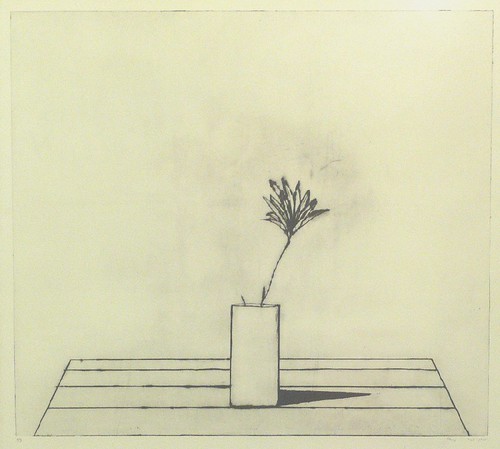
Flower in a vase

etching, 60X40 cm

Wednesday, February 14, 2007

An excerpt from Jean Baudrillard:

"Reality itself founders in hyperrealism, the meticulous reduplication of the real, preferably through another, reproductive medium, such as photography. From medium to medium, the real is volatilized, becoming an allegory of death. But it is also, in a sense, reinforced through its own destruction. It becomes reality for its own sake, the fetishism of the lost object: no longer the object of representation, but the ecstasy of denial and of its own ritual extermination: the hyperreal. Realism had already inaugurated this process...The rhetoric of the real signaled its gravely altered status (its golden age was characterized by an innocence of language in which it was not obliged to redouble what it said with a reality effect).

Surrealism remained within the purview of the realism it contested - but also redoubled - through its rupture with the Imaginary. The hyperreal represents a much more advanced stage insofar as it manages to efface even this contradiction between the real and the imaginary. Unreality no longer resides in the dream or fantasy, or in the beyond, but in the real's hallucinatory resemblance to itself."

An excerpt from Jean Baudrillard - "Symbolic Exchange and Death," originally published in Paris, in 1976.

End of a New Dawn

End of a New Dawn series of photographed paintings by Andre von Morisse

Above the City, 2004 Selenium toned silver gelatin print mounted on aluminum 42 1/4 x 41 1/4 inches

from his interview:

Why show photographs of paintings rather than the paintings themselves?

"As I was sketching my ideas, I thought about how we perceive a painted image as opposed to a photographed image. When photography first appeared, it seemed to eclipse painting as the privileged medium for the documentation of the real. Painting, by comparison, was viewed as subjective—its depicted reality mediated by personal vision and artistic skill. Photography became the truthful reference for subjective painting.In this show I reverse the traditional roles of the two mediums using paintings as the starting point for an elaborate and intricate photographic process. The paintings become conceptual “negatives”. The resulting soft-focus black-and-white silver gelatin prints recontextualize the painted images into the often unquestioned realm of photographic truth.“End of a New Dawn” is also a reflection of the end of classical photography as digital is taking over. "

via the morning news

Tuesday, February 13, 2007

SkyScraper

Works by John Woolf

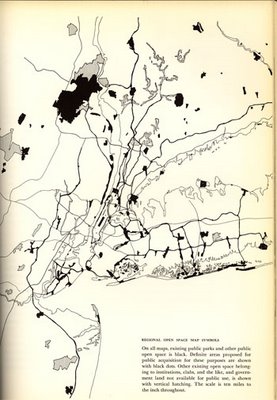
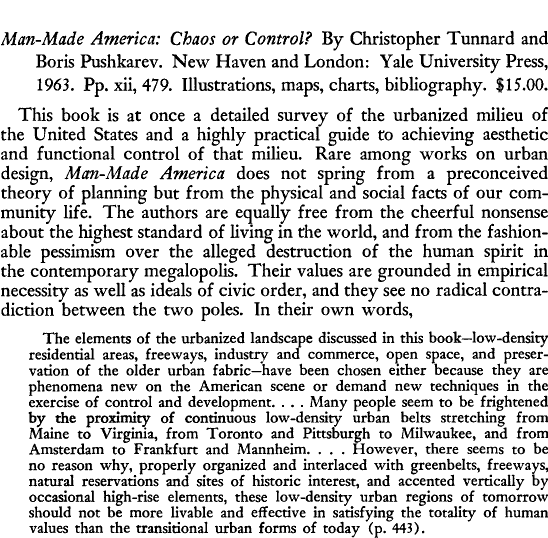
Man-Made America: Chaos or Control?

Nathan, this one is for you:

(and i wonder if you are familiar with this book)

Again mentioning books I haven't read, but would love to, one of these days...

via transfer

Man-Made America: Chaos or Control?: An Inquiry into Selected Problems of Design in the Urbanized Landscape, New Haven: Yale University Press(1963).

In It Christopher Tunnard and Boris Pushkarev argued that the built environment must be planned everywhere. Whereas the authors eschewed stylistic analysis and stressed newly emerging elements like freeways and subdivisions, they still hoped to aestheticize the landscape according to customary notions of order and beauty.

here's a review on the book:

read more book reviews about landscape

Monday, February 12, 2007

L A N D S C A P E S

Oil paintings by Gilad Efrat and photography by Taiji Matsue

Gilad Efrat

Taiji Matsue

Taiji Matsue JP-22 No. 46, 2005

Taiji Matsue
. 'YOK 0279' . 2002, Gelatin silver print 50x61 cm

Taiji Matsue. 'JP-22 No. 59' . 2005, C-print 50x61 cm

Sunday, February 11, 2007

Body mapping – telling where it hurts

The technique of body mapping is one that has been developed by union colleagues in North and South America. It helps to get people talking about the effects of work on their health. It enables safety representatives to identify clusters of common problems and their causes. It gets workers thinking about possible solutions to problems. The principle behind it is simple. The body map is a chart showing the front and back view of a body. Using coloured pens or stickers, workers doing a particular type of job are encouraged to mark on the chart where they suffer pain or injury while they are working.

read on

Memory Palace

by Won Ju Lim Memory Palace 2004. Lightbox, frosted mylar, containing sculpture made of mixed media

Friday, February 09, 2007

Paul Auster's cities roads and street

17 years ago, while living in Paris, being a young pregnant mother to come, while i was not wondering the endless streets and gorgeous gardens, the art galleries and museums, going down to the river -sitting on the dock -staring at the tourists boats at night time, passing under the stones carved old bridges, and lighting with their floodlights all what is around: the dark water, crating an outstanding theatrical scene of gigantic trees shadows falling on the building behind, and visionary scenery of ancient cities in the water - i was reading Paul Auster's The New York Trilogy - and was completely absorbed by it-maybe in reflected my own a quest for my own identity...the never ending one...

Naoya Hatakeyama: River Series / Shadow, 2002

In the following piece,

Markus Rheindorf looks to the roads and streets of Auster’s cities, detailing a peculiar process of urban embodiment that involves blending in or disappearing as a negotiation between the internal and external. and Richard Swope writes about City of Glass(a part of the trilogy), analyzing the relationship between the story's protagonist and the city he inhabits (or the city that inhabits him).

Vera Lutter. 155 West 66 Street, New york City, VIII : August 25, 2005 2005 Unique camera obscura, silver-gelatin print 191.6 x 127.8 cm

NEW TERRITORIES

Naoya Hatakeyama known by his 'Blast' series, and River Series has lots of beautiful works.

from L.A.Galerie (to explore!)

Naoya Hatakeyama Lime Hills (Quarry Series), 1986-91#23514C-Print, 30,8 x 38 cm

Naoya Hatakeyama Lime Hills (Quarry Series), 1986-91#27403C-Print, 30,8 x 38 cm

THE CYCLE-LOGICAL LOGIC OF RECYCLING

PHOEBE WASHBURN

True, False, and Slightly Better (Figure 0002)2003Dimensions variableMixed media

Thursday, February 08, 2007

Report

Flash Fiction by Ranbir Sidhu

Not the whole foot, perhaps, but only the toes. Or perhaps not only the toes but the whole foot. Perhaps the ankle, the shins, the knees wet. Perhaps more than the whole foot dips into the water.

Not the whole body, but the chest, sometimes the arms, or if the whole body then the whole body is gone, disappeared. It is a lost body, a dark shape under cold water, the shadow of a cloud.

And if not standing, then crouching, and if not crouching, then shivering, arms wrapped around oneself, water dripping onto the sand.

And if not the sound of a motorboat, it is the sound of a helicopter; and if not the latter, then the former. Not fading, not thinning the way a motor lost to distance does, but pushing up on itself, one sound beaching on the dune of the one ahead.

Not sun, or not sun any longer; or if sun, then a sun hidden, a total eclipse; and if not sun, then night, clouds covering the stars; and if not clouds, then one's eyes do not even bother to look up as one runs.

Not your own breath, running, the sound of footfalls on the sand, on the hard gravel, on the grass, on the pavement, on the grass. The sound of footfalls behind as one runs on the grass and the sound of footfalls on the gravel come ahead, close in, grow louder, the sound of one's footfalls on the gravel and the sound, behind, of feet on the sand.

via mad hatters review

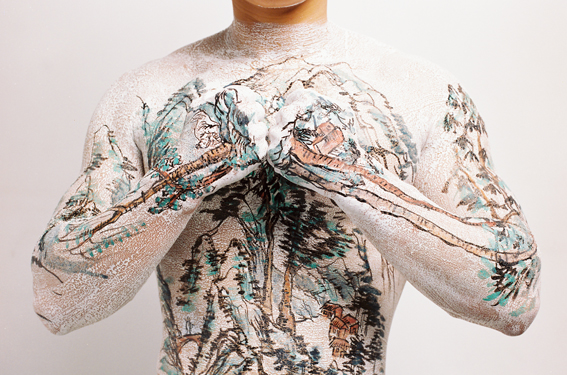
BODY TALK

by Huang Yan, from the East Link Gallery. via bldgblog

Wednesday, February 07, 2007

So where does painting start and photography end?

From Pedro Meyer of Zone Zero essay:

"I believe we have entered a new era where the once defined limits between photography and painting, and their respective fields of activity no longer have very meaningful boundaries."

And he is quoting Francis Bacon: "One thing which has never been really worked out is how photography has completely altered figurative painting.” It has been clear for quite some time now, however, that photography has in fact influenced painting. And yet, it remains unclear how painting has been"

read on and in pdf via lensculture

Roi Kuper. "Atlantis", first part of the: "To Eat of the Leviathan Flesh" trilogy 2007color prints 63 x 63 cm.

Patch/Work

Charles LeDray Patch/Work, 2002 fabric, embroidery floss, thread, leather, paint, ink, steel 38 x 34 1/2 x 1 1/2 inches 96.5 x 87.6 x 3.8 cm SW 03011 Private Collection

Tuesday, February 06, 2007

STONES IN MY PATHWAY

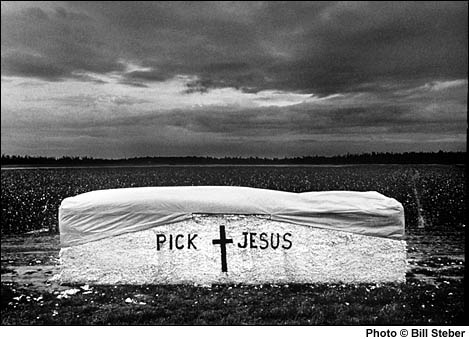
Photo essay (and music) by Bill Steber about Mississippi Blues Culture.

Pick Jesus, Belen, MS 1994

"...The same Mississippi soil that transformed the Delta into the land of king cotton with the sweat and suffering of slaves and sharecroppers also produced a cultural legacy of music, religion, and rural traditions, that shaped and defined the African-American community. The Blues, our country's first original music, was born of field hollers, railroad chants, black spirituals, jump-ups, European folk music and the ability of the human spirit to dignify itself in the face of oppression. These photographs are an attempt to document the living legacy of this rich cultural tradition."

via design observer

Mapping Radio stations

This interactive map shows what’s playing on radio stations around the country(USA).

YES makes radio and TV interactive and social. On the homepage you see the 100 most popular songs as voted by the audience of the nation's top 2,600 Radio and virtually all Music TV Stations. via http://randomwalks.com/

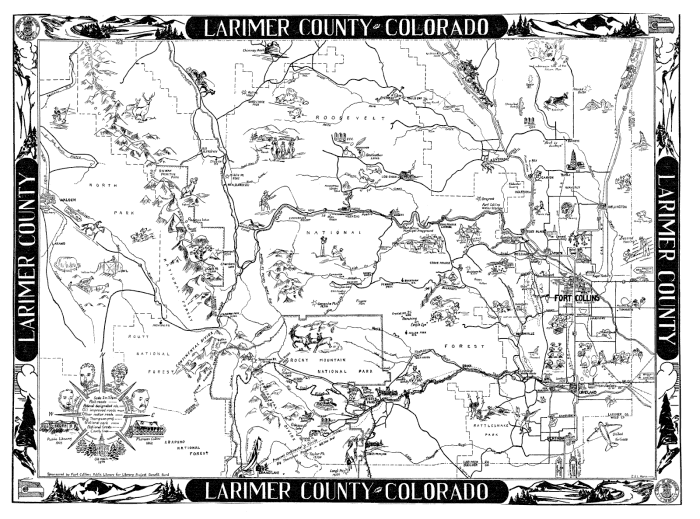
Time Capsule Map

This map was found in November of 2000 when Larimer County officials opened time capsules from the Larimer County Courthouse in Fort Collins. These time capsules were concealed behind the cornerstone wall located near the Oak Street entrance of the south wing of the building.

This map was produced by E&L Horn for the City of Fort Collins' Public Library Project Benefit Fund. The research puts the map at about 1937 - 1938.

In 1937 a library expansion project was approved by the City of Fort Collins. This map probably may have been used to generate funds for this project. The project was completed in 1939. A Fort Collins Public Library research we conducted turned up a Fort Collins Chamber of Commerce brochure produced in 1935 that contained a very similar map, author unknown.

"..Each man's life represents a road towards himself, an attempt at such a road, the intimidation of a path.. No man has ever been entirely and completely himself. Yet each one strives to become that--one in an awkward, the other in a more intelligent way, each as best as he can."

Herman Hesse Demian

via joaobambu flickr

Monday, February 05, 2007

WetLands

These days Ocean depiction seems to invade my world intensively. only few days ago i was privileged to discover the breath taking photographic works by Clifford Ross, and i can not mention the poetic works by Roi Kuper, especially his Sea photography as well as of genius works by the Japanese artist Hiroshi Sugimoto, and Alec Soth's dramatic Fall scenes.

The photo below belongs to Artist Cheryl Van Hooven

Cheryl Van Hooven, Untitled (starred Riverskin) 2001-2002, Manipulated C-print, 40"x30"