The next big thing will be lots of little things: US
"a flowering of ways in which non-hierarchical approaches contribute to the quality of life at local level." read ON
"a flowering of ways in which non-hierarchical approaches contribute to the quality of life at local level." read ON
Liz Strauss on bloGGing "Blogging is the tipping point of communication because no other form of communication has been so immediate, so interactive, so far-reaching and so ready-made for relationships. " "We are connectors and mavens at the tipping point of communication able to make relationships with people all over the planet."
From an essey by Terence McKenna, a controversial theoretician and a powerful voice for the psychedelic movement.
"Ancient mapmakers relied upon the presence of celestial bodies for their conceptualization of the world, for their external knowledge-making tools, as if a far-off body could help to make sense of our terrestial life/as if it couldn't. Cosmology, as a practice, relied on the construction of an external body of knowledge that the local meaning-maker could situate him- or herself into, and more broadly, their entire society and culture -- the interior is determined by its relationship to the exterior (or the exteriorized). "
"For the ancient Greeks then, the font of Western culture, this cosmology works at once to legitimate the presence of humanity on this terrestrial sphere, as well as providing proof, facticity, for the mapmaker's art: Cosmology not only gives humanity a narrative of its coming into being, but also a rationale for humanity to exist as part of a whole universe. Hesiod, in his relating of the beginnings of terrestrial history, begins with Chaos, with the yawning chasm of the unfilled cosmos -- the eternal vacuum. Into this Chaos, Gaia is parthenogenically born, the first entity, as Hesiod explains that Chaos is no entity at all, but the absence of identity. But whence the earth, dialectical identity is confirmed. And Gaia firstly gives birth to Sky, to blanket her, for comfort. An into this sky, Erebos, the lightless depths of the night, and Nyx, pure night. To them is born Aither, the light of heaven, and Hemera, the day. Gaia proceeds to give birth to her terrestrial children, the mountains, the rivers and seas, the deserts, and the forested wilderness; her first concerns are creating those land-marks that humanity will come to know itself by. Both the person and the tribe, the latter a faulty category imposed by the perception of the world lived in, and the geographical barriers between people. Later, Prometheus and Epimetheus will distinguish humanity from the other animals of the Earth, but through a dependency on their lack -- as if Gaia's gift of a terrestrially founded identity was insufficient......."
"....But these maps are to be burned. No longer do we have external bodies to find, to navigate; our labyrinths are internal, ideological, and imaginary. Our new cosmology is a political one, a purely theoretical one, and one that is as arbitrary as it is necessary. But in this arbitrariness, there is no need to dismantle it: Rather, these mazes of identity are to be celebrated and understood -- the endless labyrinth must become an understandable game of the self. "
"And so we imagine ourselves ancient mapmakers. We rely upon the presence of celestial bodies (the stars of our own reality shows), (re)constructing the world as it has never been seen. Like idiots we stumble across external knowledge-making tools of our own creation, and find ourselves distracted as we march headlong into a future filled with stories of a past we can't remember. But when we look outside of ourselves, and listen to someone else's story, however false or unintelligible it may seem, we begin to triangulate our positions. We mark off locations spatial and temporal and enter into an emerging social sphere. And though our skies may be obscured by the dromospheric pollution of continent-crushing velocity, we begin the cartography of the social. A project for our own times, always changing and never complete, but it does become better, provided we continue to reach towards each other, looking long and hard for new stars to join new constellations, in search of a place we have yet to imagine. "
Geographically located iTunes Libraries.
A total of 14,132 lines make up the image.
a project
by by Caleb Larsen

"I contacted 40 friends of mine and asked them to send my a copy of their iTunes music library file. This is the file that contains all the information regarding the songs, artists, albums, and listening habits for a digital music library. I wrote a PHP program that threw all of the libraries into a database and located each library based on the latitude and longitude of where the person lives. A vague form of the United States can be seen (Seattle in the upper left, NYC on the right). Lines are drawn between the albums that one person has in common with another. Each album is represented by a small dot in the Library graph. The point's grey scale value is determined by the frequency with which the album has been listened, the tone of the line connecting albums is an average of the starting and ending points".

detail image.

Fernhurst village - parish map, detail
Everywhere means something to someone. You don't have to own it, or even see it everyday, for a place, and its stories to be important to you. The combination of commonplace histories and ordinary nature makes places what they are. Things do not have to be spectacular, rare or endangered for people to value them and want them about their everyday lives. For visitors, a Parish Map offers a new way of looking at a place, and shows a glimpse of the vibrant life behind the obvious.
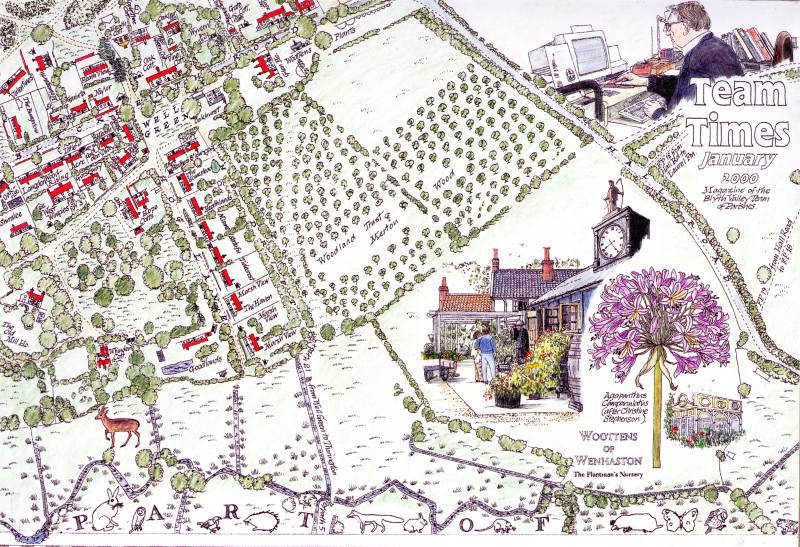
A Parish Map demonstrates what people claim as their own locality and what they value in it - wild life, history, work, landmarks, buildings, people, festivals. It does not have to be precise or cartographically correct, but by illustrating locally distinctive activities and features, it helps you to focus on the everyday things that make your place significant to you and different from the next. It can include the elusive responses which cannot be measured or counted and also the invisible - the stories, dialect, names and fragments of everyone's history.
Parish maps are pictorial and decorative. Typically they have main three main strands - a strong feeling for the past, the present day and local wildlife.
Wenhaston Millennium Map - an amazing parish map, it is divided into 24 panels. To view the panels in detail just click on any part of the picture above and that panel will open. To preserve all the detail the images are around 100 - 150kb so will take a few moments to load. Please be patient.
see as well the Chidham and Hambrook - The Parish Plan Parish Maps are a starting point for local action, they are demonstrative, subjective statements made by and for a community, exploring and showing what it cares about in its locality. They offer a way of communicating creatively and socially how rich everyday places are, and what importance seemingly ordinary things have to everyone. All kinds of people old and young, from varied cultural backgrounds, by sharing their ideas and knowledge, begin to cherish their locality more and often become involved directly in its care. Parish Maps can be made by anyone, in any way, of any place. 'Parish' is offered not to define but to describe the scale at which people feel a sense of familiarity and ownership in their place: home place, your own familiar territory, the neighbourhood to which you feel a sense of belonging, the locality which 'belongs' to you. Many have defined their own edge, but others have used the Parish Boundary and indeed discovered much of history and nature by so doing.
Whether you live in a town, a city or in the country, there are some things around you which are part of your daily round. Perhaps there are buildings which seem 'at home' in the landscape because they reflect the lives of the people who lived in the area before you - a mill, a line of houses, a quay or railway station; perhaps you enjoy a walk along lanes lined with primroses in spring, through water meadows or wild fells grazed by sheep; your walk may take you between the ducks on the canal and red brick warehouses, or through the sounds and smells of the street market to school. Wherever you are, it is the detail and overlays which have meaning to you and which give your area its own local distinctiveness. Making a Parish Map can help people to come together to chart the things that they value locally, to make their voice heard amongst professionals and developers, to inform and assert their need for nature and culture on their own terms, and to begin to take action and some control in shaping the future of their place. via england-in-particular and commonground The ecclesiastical parish has been the measure of the English land-scape since Anglo-Saxon times. Boundaries, some dating back more than a thousand years, are often still traceable; here, history marches with nature and each is the richer for the discourse. This tracery may be tangible in the city as the curving line of a street, or in the country as the double bank and ditch dancing with butterflies. For although dynamism is an identifying feature of nature, broad continuity creates the conditions for the changes to build each on the other, species to diversify, ecosystems to mature.

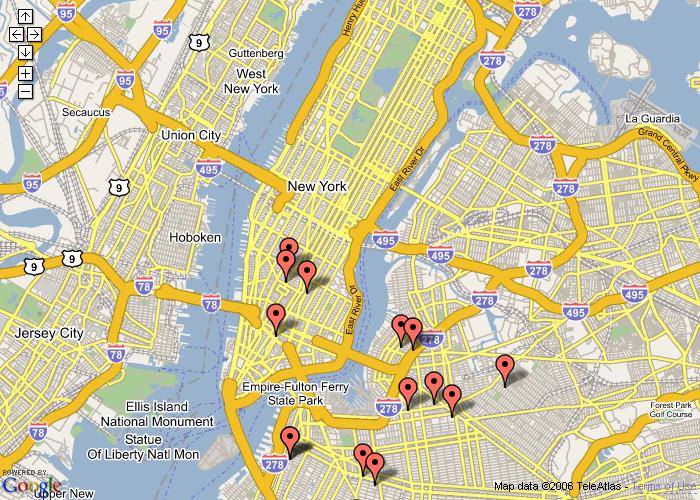
A dropspot is a kind of alternative mailbox. It’s a hiding place in a public space, where people can leave things for exchange... Go to Drop Spots, and put your drop spot on the map.

 Posts
All Comments
Posts
All Comments