In the beginning, maps were fiction.
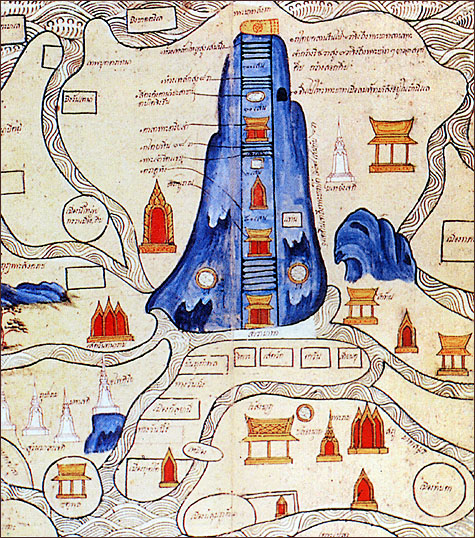
Inherited from the past were the fables and legends of Greece and Rome, along with tales from Celtic and Norse mythology. These were blended with information brought back by occasional mariners, who, in expanding their trade routes, ventured a bit farther than any before them, or by chance came upon an unknown island when tempestuous weather blew their vessel off course. Gradually, this mixture of legend, speculation, and travelers' tales began to be replaced by a new kind of geographic knowledge, one that was the result of direct observation.
We perceived our world as myths defined by belief not geography. Maps of these imagined worlds came in many shapes and sizes, but they all mixed the unreal with snippets of the real world. The process of mapping the real world was one of going from geographies of ideas to maps of real geography. On the Internet, we will pursue a reverse path: maps of the Internet will progress from our current maps of network topologies to maps of virtual worlds that we build, maps of ideas and thoughts.
Coined by Alfred Korzybski, The map is not the territory is a related expression meaning that an abstraction derived from something, or a reaction to it, is not the thing itself, e.g. the pain from a stone falling on your foot is not the stone; one's opinion of a politician, favorable or unfavorable, is not that person, and so on. A specific abstraction or reaction does not capture all facets of its source and thus may limit an individual's understanding and cognitive abilities unless the two are distinguished.
Computer-based digital multimedia is made palpable within highly mutable electronic environments. The very nature of our understanding of context has been altered because of the unfixity of these technological surroundings. The potential for instant distributed connection to other computers on an international scale also adds to this complexity. All of this activity takes place in what could be called an environment of "Simulacra and Simulation."
 Lawrence Wiener, NACH ALLES/AFTER ALL, 2000. Language, Dimensions variable. Solomon R. Guggenheim Museum, Commissioned by Deutsche Bank AG in Consultation with the Solomon R. Guggenheim Foundation for the Deutsche Guggenheim Berlin. 2006.6. © 2005 Lawrence Weiner/Artists Rights Society (ARS), New York.
In his book Simulacra & Simulation, Baudrillard argues the following:
Lawrence Wiener, NACH ALLES/AFTER ALL, 2000. Language, Dimensions variable. Solomon R. Guggenheim Museum, Commissioned by Deutsche Bank AG in Consultation with the Solomon R. Guggenheim Foundation for the Deutsche Guggenheim Berlin. 2006.6. © 2005 Lawrence Weiner/Artists Rights Society (ARS), New York.
In his book Simulacra & Simulation, Baudrillard argues the following:
Today abstraction is no longer that of the map, the double, the mirror, or the concept. Simulation is no longer that of a territory, a referential being or substance. It is the generation by models of a real without origin or reality: A hypperreal. The territory no longer preceeds the map, nor does it survive it. It is never the less the map that proceeds the territory - pressesion of simulacra- that engenders the territory. (Baudrillard, 1994) via




 Posts
Posts


