GEOLOGY OF THE MOON
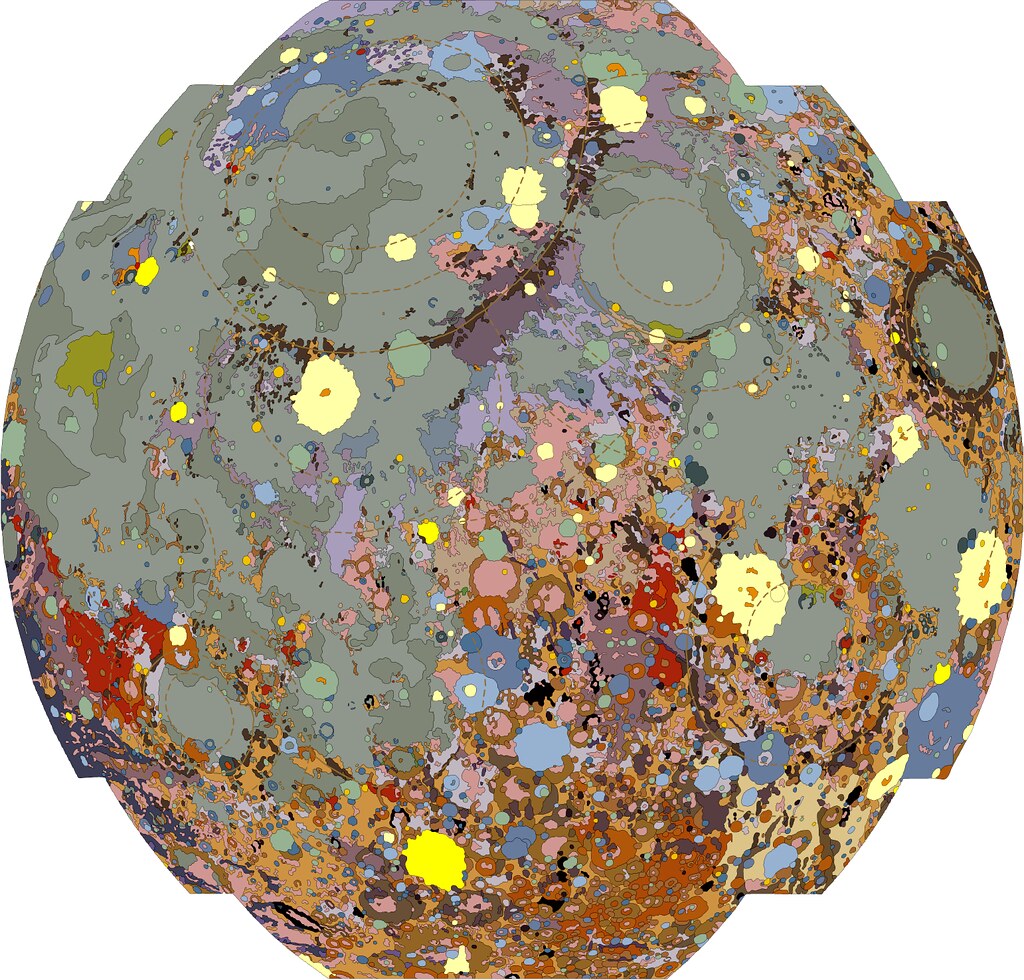
Gems of pure beauty, found buried in a government website. and found at the radicalcartography web site
Gems of pure beauty, found buried in a government website. and found at the radicalcartography web site
sadly, i can't credit rightfully the author of this digital photograph, for this photo is from a site all in Greek. but couldn't resist this cypress with the moon's halo
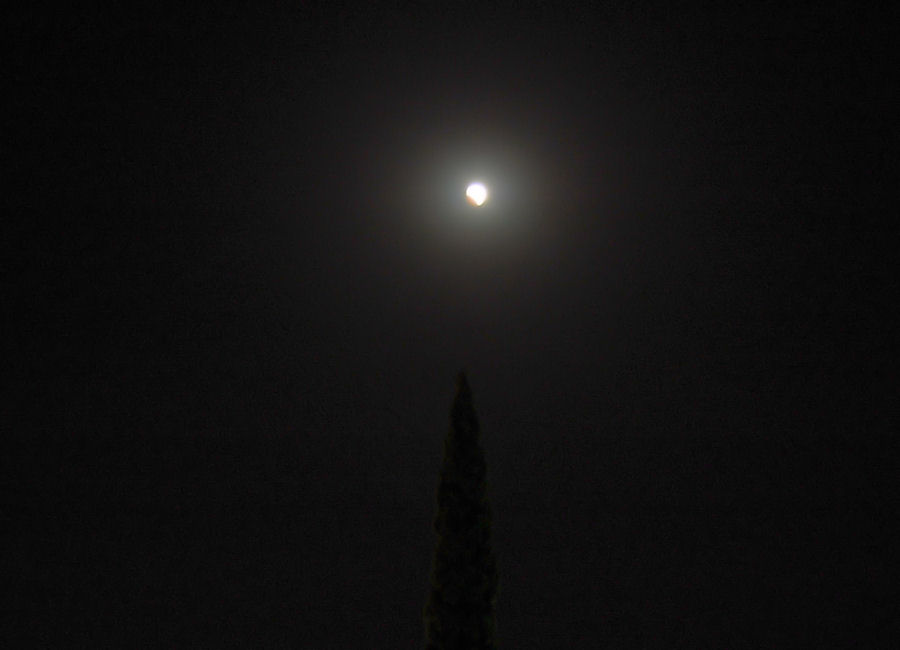
'The moon over on the tree'
thanks Spiros
by Quoc To taken at year 2000, somewhere in Vietnam
.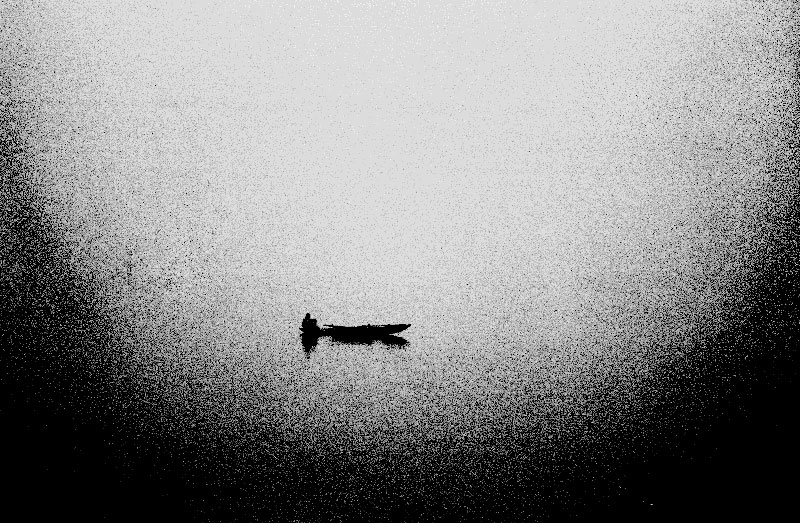
http://www.trekearth.com/gallery/Asia/Vietnam/photo465500.htm
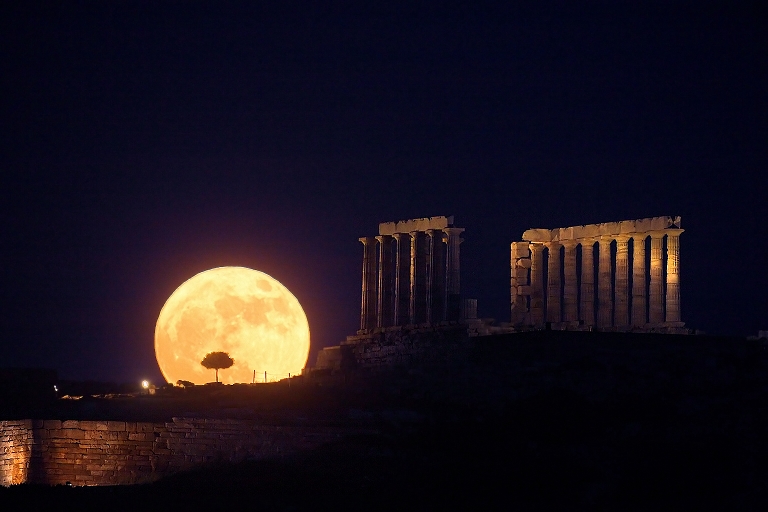
Astronomer Anthony Ayiomamitis recorded this dramatic picture of the solstice Full Moon rising above Cape Sounion, Greece.
John Pfahl. from his 
In a childish attempt i'm trying to find trace to the origins of "moon river" ...
the moon river song writers , didn't realy gave an explanaion that satisfied me, so i went to antiquity, to try and find out....came up with few clus:
The moon is often an archetypal woman image. In many cultures and religious orders, the moon is identified as a mother figure. This is true in Native American, African (In African legends, the moon (which is often the traditional location of heaven) is interchangeable with a Christian type heaven - this may be due to European influence), Christian, and Eastern literature and lore.
If the Moon has been more identified in our contemporary cultural myths with the passive side of women, it also exerts tremendous power (not unlike women) as it controls the tides in the oceans and the
Moon \Moon\, v. i.
To act if moonstruck; to wander or gaze about in an abstracted manner.
[1913 Webster]
Elsley was mooning down the river by himself. --C. Kingsley. [1913 Webster]
******
The origin of this babylonian-assyrian main goddess was a semitian vegetation- and moon goddess with lower influence, but when these tribes arrived at the land of the sumerian kingdom, her cult reached the sumerian capital Uruk. The sumerian people identified Ishtar easily with their own goddess Inanna. After some time Ishtar became in the second millenium the highest and widest worshipped goddess of the Babylonians. The myths of Inanna became the myths of Ishtar:
Her consort or husband was Tammuz ( sum.: Dumuzi), River God of Euphrates and Tigris, who was meanwhile also her son and her brother. When the world began, Tammuz (faithful son) came together with Ishtar in the world. She bore him, she made love with him and she remained a virgin. When Tammuz died in the summer and all vegetation died with him, Ishtar was looking for him all over the world. She finally found him in the underworld and brought him back to life. Tammuz was reborn and the vegetation could flourish again. Then the ritual-festival of the "Holy Marriage"(Honey Moon?) was celebrated at the time of the autumn equinox, when in the Near-East the first rain fell again.
There is a Chinese legend, in which a hero named Chang Ki'en reached the moon by sailing up the River Huang Ho. When he got there he met the god of love and marriage,
******
In the 5th century B.C. Herodotus visited Egypt and travelled up the Nile as far as Elephantine. On his journey, he met a priest who claimed to know where the source of the Nile was. There were apparently two mountains called Crophi and Mophi, and in the centre of each was a vast bottomless fountain. These two fountains gave rise to the Nile. Ptolemy (A.D. 90 - A.D. 168) elaborated upon this story, and located the fountains in a range of mountains south of the equator, which he named "
Arab explorers in the dark ages spoke of the Mountains of Gumr. Gumr was believed to be a corruption of Kama meaning moon.
It is said that those who saw it saw bright snows like white silver gleaming with light. Whoever looked at them became attracted and stuck to them until they died and this science is called human magnetism. It is said that a certain king sent an expedition to discover the Nile sources and they reached copper mountains and when the sun rose the rays reflected were so strong they were burntIt is said that in the days of Am Kaam, one of the kings of Egypt, Idrisi was taken up to heaven and he prophesied the coming of the flood so he remained on the other side of the equator and there built a palace on the slopes of Mount Gumr. He built it out of copper and made 85 statues of copper, the waters of the Nile flowing through the mouths of these statues and then flowing into a great lake and thence to Egypt"
After this the
Mountains of the Moon:
almost at the equator
almost at the equinox
exactly at midnight
from a ship
the full
moon
in the center of the sky.
Gary Snyder
for those who are fascinated by Joseph Cornell art, that for me represent the wonder and the ability to manifest the universe in a box, this site provides access to the papers of Joseph Cornell that were digitized in 2006 by the Archives of American Art. The papers have been scanned in their entirety, and total 32,775 images.
Series consists of Cornell's two-dimensional and textual source material and is largely comprised of files of clippings, notes, writings, stats, cutouts, and other printed material, stemming from his various artistic, research, writing, collecting, and collating activities.


The Moon Museum was delivered to the Moon by the crew of Apollo 12 on board a Saturn V rocket (Earth Launch Date: November 14, 1969. Moon Landing Date: November 24, 1969).
The Moon Museum 1969, is a small ceramic tile carried on Apollo 12 on which American artists Robert Rauschenberg drew a straight line; Andy Warhol drew a penis; Claus Oldenberg drew the image of Mickey Mouse; and John Chamberlain, Forrest Myers and David Novros all drew geometric designs. ~ Hoban, 1985.


Miniaturized and iridium-plated drawings on ceramic wafer.Plate measures 3/4" x 1/2" x 1/40".
via
more astonishing Moon Art
as i found out that I'm intrigued by the concept of a moonlight garden, i was delighted to find this historic reference.
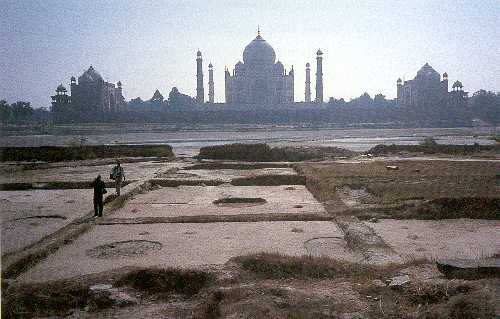
Mahtab Bagh is situated on the sandy bank of Yamuna River just opposite the Taj Mahal mausoleum.Located across the river from the Taj Mahal, the Mahtab Bagh (or Moonlight Garden) was a pleasure garden built by Shah Jahan in the 1600’s. From this vantage point, the emperor could relax and enjoy the vista of his great work in a setting of fountains and airy pavilions.
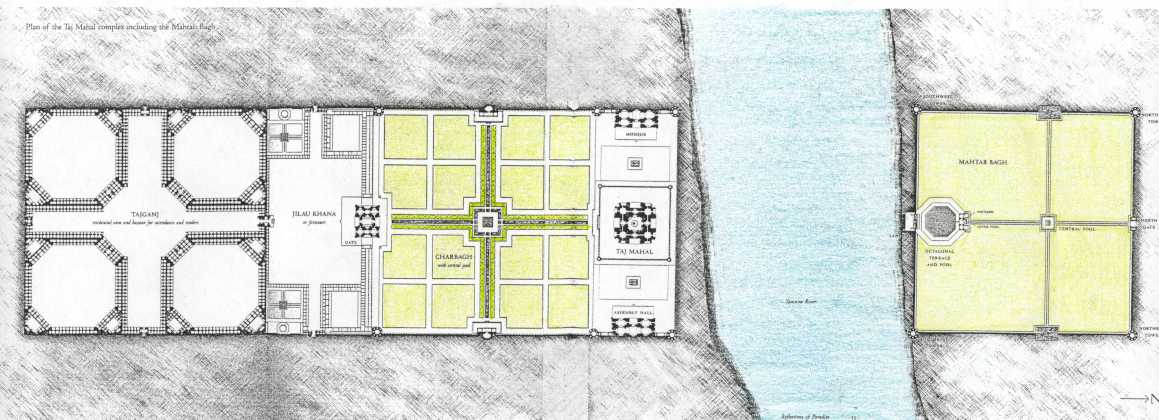
Plan of the Taj Mahal Complex including the Mahtab Bagh
The place is an ideal spot for it provides picturesque view of Taj Mahal. The name Mehtab Bagh means 'Moon Lit Garden' and the same was testified by the beautiful reflection of Taj Mahal in the pool at night in Mahtab Bagh. The place has a history of its own. It is believed that the great emperor Shah Jahan who built Taj Mahal for his queen wanted an identical one for himself at Mehtab Bagh (or was an extension of the Taj Mahal garden). However the archaeological findings have proved the existence of garden complex. The important attraction of Mehtab Bagh is Taj Mahal itself.
The garden has been renovated by the Archaeological Survey according to the original plan. The place has been enriched with vegetation and at present more than 40 species of plants bloom in the garden.
Satellite imaging and an old plan of the Taj complex indicate that Mahtab Bagh was an extension of the gardens across the river:
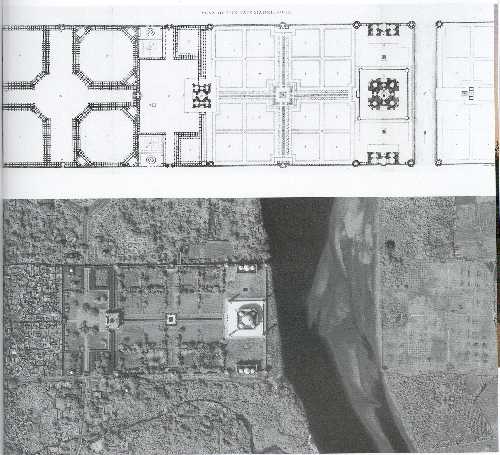
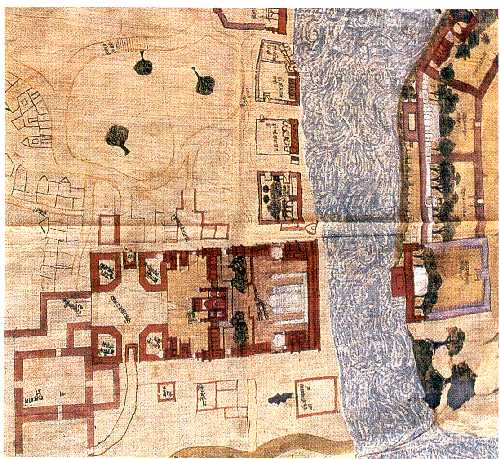
Elizabeth B Moynihan's book, draws on an archaeological investigation of a garden opposite the Taj Mahal, originally forming part of a single composition. via the book ‘The Moonlight Garden’ – New Discoveries at the Taj Mahal
LYRICS by radiohead
I sucked the moon
I spoke too soon
And how much did it cost?
I was dropped from
Moonbeams
And sailed on shooting stars
Maybe you'll
Be president
But know right from wrong
Or in the flood
You'll build an Ark
And sail us to the moon
Sail us to the moon
Sail us to the moon
Sail us to the moon
US plans for Moon base- this article examine possible strategies for how a future lunar base may come about, and what benefits could be reaped from it.

via baddaystudio
In Colonizing The Moon article, some senarios seems just too good to be true, "A number of sources have made a point of mentioning that on the moon, the average person is light enough to fly under his own power, if given wings and air to fly in. Some space entrepreneurs envision enormous inflatable domes where people could strap on oversized, lightweight polymer wings and do just that".
From KurzweilAI.net - and article about Imaginative new ideas for using space to protect civilization against existential risks, such as killer asteroids, nuclear war, global terrorism and seeing the Moon as backup drive for civilization .
interactive QuickTime VR Panoramas in full-screen from the 6 Apollo Missions who landed on moon. All panoramas includes original audio clips. and i must say it looks more fictional then real...

via thingsmagazine and kottke
by Steve Roden's site {and blog}
'The Surface of the Moon' was inspired by a list of «craters, mountains, and other objects» on the moon from a turn of the century map in an astronomy book called Celestial Objects for common Telescopes, by Thomas William Webb that was published for the first time in 1859.
The number of objects (sculptures) that make up the work is 490 - the same number of land formations on the list - all that were known to exist around 1910.

The Surface of the Moon, 2001approx. 24" x 1" x 840"wood, wire, wax, gesso, pencil, tin foil.

by Ethel Anderson for The Atlantic Monthly, August, 1936 .
A moonlight garden is best built above the sea, for the moon never shines so brightly as on salt water; and although the moon's scintillations filter pleasantly enough through fresh water, there seems to be on the surface of the sea an oily, resilient patina that amplifies her rays, and sends them rebounding upwards, like rain on slate. .
Fresh water, as it appears, absorbs light; salt water, in sparkling regurgitations, refracts it; and there may be a still more deeply rooted affinity between the moon and the sea than is generally guessed at, for an oceanic vastness alone hardly explains why lunar tides swing the ocean, yet cause no rhythmic flux, no ebb and flow, of inland seas, or freshwater lakes, or rivers. Below the sea we know lies an unknown, a stranger sea, as black as coal, as dense as rock, as cold as ice, where the fish, supporting on their fins the weight of half the world, move like arc lights.This submerged ocean is the mercury backing the sea's glass; this is the culet of a diamond which has for girdle the earth's immeasurable seashores, and for table the moon's disk. Its facets intensify the radiance of moonlight on salt water. That our vision shows us but one such nexus to the moon is a disadvantage that may be alleviated somewhat by the plan of the garden, which should have a central path running due north to facilitate the enjoyment of the zenith or lunar noon, a path going eastwards to greet the rising moon, and a third traveling westward toward its setting.
. All dipping finally into the sea, these paths should be proportioned as was a Crusader's sword, the east- and west-going paths cut short, like the cross on the hilt, the northern path long, like the sword blade. The pommel would give the hint, dimensionally, for a fourth path, having at its tip the doorway into the garden; it should have but a little gate. .

ALVIN LANGDON COBURN, The Intelligence of Flowers, 19078.5 x 13.7 cm ....
A basin to hold the stars should be put where the four pathways meet. Their dark foliage pitted by the Pleiades, or by wheeling Orion, with tiny sequins of light, four magnolia trees, placed so that they do not overshadow it, may flank the basin. While the walks in a moonlight garden are best made of light colored granite (marble, unless it be liberally clouded over with pink, is too white), the star basin should be lined with malachite or black marble, or some other dark substance, so that Betelgeuse or Aldebaran lost nothing in the reflecting.
For this reason the water should be sunk, lest the winds ruffle it, below the rim of the platter. Yet it should not be set down so deep that a hand may not reach the stars.
.

.
Since lotus buds in the moonlight open so quickly that it is possible to hear the plop the petals make in sundering, as if they kissed at parting, since the yellow water lilies of the Euphrates or the dim Asian kinds blossom only at night, it is a temptation, to some, to mix lilies in with the stars in the basin. But it is better to limit oneself to the galaxy. For lilies, unlike violets, have no legendary association with the sea. White violets may be scattered lightly over the rocks, well above the inrush of spray at high tide. But lilies are landlubbers.
It is not known how souls are begotten. That they may grow on the human mind, parasites of experience, gives life but a tame climax. That they are in reality begotten in mystic intercourse with a Divine Consonance, that those who are, in the body, childless may yet be the foremost breeders of souls, is a theory not without appeal; and as a breeding ground for souls a moonlight garden may have its uses, particularly if it harbors a crooked acacia, whose tarnished, off-white blossoms may brush the moon with silver, may stir the senses with exhalations so sweet, so faint, so fleeting, that only souls can catch them.
A moon bow, though among the rarest is not the least brilliant of the diadems of night. Snaring within its triple arches humid cerulean, veiled rose, saffron, purple, lime-green smeared with maize, it echoes palely a rainbow's hardier chromatics. A moon bow is never so rare that it may not be hoped for; in rainy weather, with a full moon moving in puffs of light through a piebald sky, a moonlight gardener may expect to see one.
.

Moonbow thru the Pleiades via
. It is wisest to let unserried waves of fringed hydrangeas break, whiter than arctic snows, against the edges of all the granite paths, lines of moonflowers, their milky pendants brilliant as candelabra, linked with them as seventh waves. Beyond the moonflowers stone pilasters must lift up feathery cascades of white wistarias, some fifty or sixty vines spreading out into fans of ebullient foam. White azaleas, and acacias, and oleanders must fringe the limits of the garden, the flash of surf in the shelving bays beneath them always glittering through their exquisite intricacies of branch and bough.
When in silver flocks the sea birds troop home across this silent,lovely promontory, some sea eagle or migrant white owl may stay to rest in the acacia boughs, or some deft osprey fish from the granite steps that dip into the sea, or a white, languid peacock may be cajoled to walk here. But if the moonlight garden is to be kept, as it should be, primarily as a hatchery for souls, it should be kept solitary.
. None but sea voices should be heard by those who frequent this garden of the moon and sea; no sound but the hesitant sibilants of the waves, and the whisper of the sea winds.
By Ethel Anderson August, 1936.
Die Wunder Der Natur - Collage made from early 1900s German natural history encylopedias and late 1800s Italian arts journals via nerds eye view
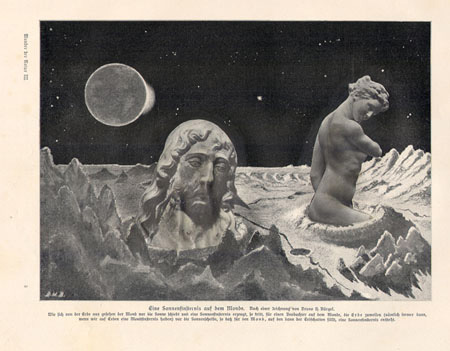
Eclipse from the Moon
This rare print taken by US photography pioneer Edward Steichen has set a world record for the highest price paid for a photograph auction.

Edward Steichen, The Pond-Moonlight - New York in 1904
Part of the reason for its value and rarity is that it is a very early example of colour photography, produced using the autochrome process. Contributing to its high price is that there are only three known copies in existence; there are two in museum collections in addition to the print sold at auction in 2006.
not very parctical, unless you woke up tomorrow morning and found yourself on the moon. what would you do? NASA has just released a list of 181 good ideas. "We consulted more than 1,000 people from businesses, academia and 13 international space agencies to come up with a master list of 181 potential lunar objectives."

 Posts
All Comments
Posts
All Comments