calligraphies

"a flowering of ways in which non-hierarchical approaches contribute to the quality of life at local level." read ON

Vlatko Čerić, Evolution #5 of 10, 2005,

Charles Csuri. Random War, 1967

Mark Wilson *("4E92" plotter ink on paper)

Roman Verostko FLOWERS OF LEARNING


"Imaging Place," is a place-based, virtual reality art project.
Since September of 2006 the"Imaging Place" is being implementing in Second Life

It takes the form of a user navigated, interactive computer program that combines panoramic photography, digital video, and three-dimensional technologies to investigate and document situations where the forces of globalization are impacting the lives of individuals in local communities. The goal of the project is to develop the technologies, the methodology and the content for truly immersive and navigable narrative, based in real places.

'"Imaging Place" is therefore experienced as a process of navigation and excavation, allowing the user to uncover many layers of history and meaning. "Imaging Place" documents sites of cultural significance that for political, social, economic, or environmental reasons are contested, undergoing substantial changes, or are at risk of destruction. This includes historic sites as well as sites of living culture that are being displaced by globalization. The project also seeks to expand the notion of documentary by exploring how place is internalized, mapping place as a state of mind. '
A project by Jonathan McCabe.
The generative system involves four linked cellular automata - think of them as layers. "Linked" because at each time step, a cell's state depends both on its neighbours in that layer, and on the states of the corresponding cells in the other three layers. Read On

via teemingvoid
6/6 frame from "Orphics: Nocturne", Digital Video, 4'40", 1995

3/6 frame from "Orphics: 5ieme Gnossienne", Digital Video, 4'00", 1996
via the great site: 
A Game To Light Up The Brain A Japanese neuroscientist has found that "if you measured the brain activity of someone who was concentrating on a single, complex task -- like studying quantum theory -- several parts of that person's brain would light up. But if you asked them to answer a rapid-fire slew of tiny, simple problems -- like basic math questions -- her or his brain would light up everywhere. Hence the design of [the computer game] Brain Age. It offers you nine different tests, some of which seem incredibly basic -- like answering flash-card math questions -- and others which are fiendishly tricky." via
A family of algorithmic pen plotted drawings, each presented with the binary text for a Universal Turing Machine (UTM), were created for an exhibition in Manchester on the occasion of the Ninth International Symposium on Electronic Art (1998). .
The artistic procedure employs a form-generation method which, by analogy to biological process, may be viewed as epigenetic. The software (code), created by the artist, behaves as genotype capable of generating a distinctive “family of forms” within any given set of parameters. The hyperspace of all possible forms, based on the specific parameter settings for this Manchester edition, is infinitely vast. 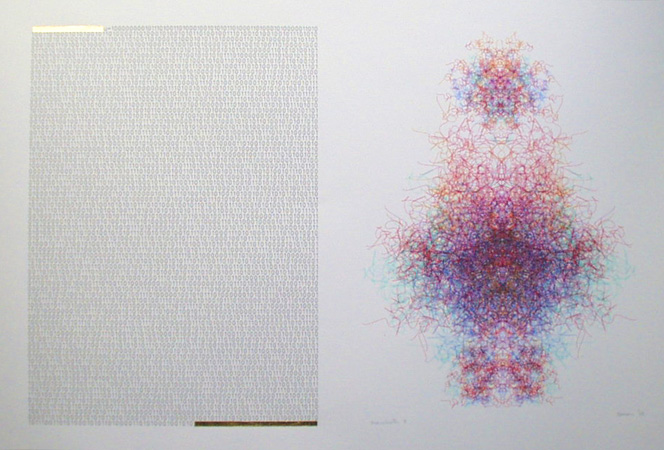
Manchester Illuminated Universal Turing Machine, #9 1998pen plotted drawing with gold leaf30" by 22" UTM - Is The gating logic for circuit boards in all general computers descends from a logical procedure known as a Universal Turing Machine (UTM). The logic for this algorithm by Alan Turing (1912-54) was written in 1936 and published in 1937 in the Proceedings of the London Mathematical Society. This paper, “On computable numbers, with an application to the Entscheidungsproblem", planted the seminal idea for all general computers.

Detail of the UTM binary text with gold leaf. Click here for full text page (719 kb).
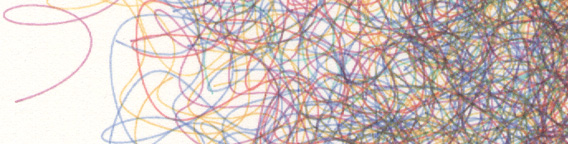
Detail shows algorithmically generated pen plotted lines from illumination #23 above
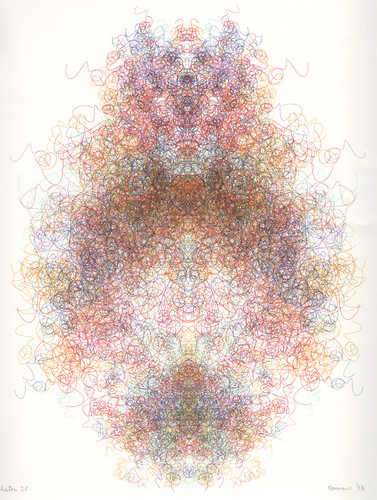
detail from one on the work of Illuminated Universal Turing Machine
Geographically located iTunes Libraries.
A total of 14,132 lines make up the image.
a project
by by Caleb Larsen

"I contacted 40 friends of mine and asked them to send my a copy of their iTunes music library file. This is the file that contains all the information regarding the songs, artists, albums, and listening habits for a digital music library. I wrote a PHP program that threw all of the libraries into a database and located each library based on the latitude and longitude of where the person lives. A vague form of the United States can be seen (Seattle in the upper left, NYC on the right). Lines are drawn between the albums that one person has in common with another. Each album is represented by a small dot in the Library graph. The point's grey scale value is determined by the frequency with which the album has been listened, the tone of the line connecting albums is an average of the starting and ending points".

detail image.

This image is a result of one of Rosemarie Fiore's projects. She took photos (long exposures) while playing video war games of the 80"™s created by Atari, Centuri and Taito. The photographs were shot from video game screens while she played the games. By recording each second of an entire game on one frame of film, she captured complex patterns not normally seen by the eye. via gatsugatsu
and CRYSTALPUNK is talking about the Kriegsspiel war-game. that was invented in the first years of the 19th century by Baron von Reisswitz, a civil administrator with an interest in military history.
We might never have heard anymore about this game, however, but the king Friedrich Wilhelm III of Prussia heard about this war game. and not long after it had become a game used for training officers in the Prussian army.

Today it is considered the grandfather of modern wargames, which is why it is horrible in every other sense. It seems this is played on real maps.
by Andy Lomas


Sympathy in White MajorAbsolution II, 2006 Butterflies and household gloss on canvas

Charles Bukowski writing a letter to a friend, February 2, 1991:
"On this computer, well things seem to take on a freshness and an excitement. I'm at the thing almost every night. It may sound over-dramatic to say it but it feels like a rebirth. In a month this baby has pumped out dozens of poems and a couple of pieces of prose. The convenience is unbelievable. Everything gets easier, the words light up and dance. What a toy, what a lark! It makes me think, what could follow the computer? This things even corrects my spelling, has a word finder, a dictionary and a realm of hidden matter that I have yet to discover. I had no idea this would be so refreshing... "
via hebig
In the early 1960s digital computers became available to artists for the first time(although they cost from $100.000 to several millions, required air conditioning, and thereforelocated in separate computer rooms, uninhabitable 'studios';programs and data had to be prepared with the keypunch, punch cards then fed into the computer;systems were not interactive and could produce only still images).
The output medium was usually a pen plotter, microfilm plotter (hybrid bwn vector CRT and a raster image device), line printer or an alphanumeric printout, which was then manually transferred into a visual medium. read all
Herbert Franke (1927, de): Lichtformen, 1953-55:

Herbert Franke's wide-ranging interests include the use of random-number generators, image-processing, numerically-controlled machine tools, iterative techniques, fractals and even a series of experiments with music produced on the self-constructed wind instrumentof colleague Bruno Spoerri.
Now day many programs are avialable for people who want to program images, animation, and sound. program such as Processing: an open source programming language and environment
It is used by students, artists, designers, architects, researchers, and hobbyists for learning, prototyping, and production. It is created to teach fundamentals of computer programming within a visual context and to serve as a software sketchbook and professional production tool. Processing is developed by artists and designers as an alternative to proprietary software tools in the same domain. view Processing Flickr album
The EDSVJ project is driven by human heart: The instalation itself is using multiple inputs influencing algorythm parametres determinating the basic outlines of the final videosequence that can be seen. The experiment is technology-wise based on real-time inputs and proce55ing software. "this experiment is based on mine understanding of computer humanization.">>
New Scientist is carrying a report that a computer can learn mapmaking: Walter Bischof and Jun Zhou, computer scientists at the University of Alberta in Edmonton, Canada, and Terry Caelli from the Australian National University in Canberra, created the new computer program, which learns to detect and track new features such as roads on standard aerial photographs.Initially, a human mapmaker proceeds manually, using mouse clicks to trace a road on a photograph. The computer program tracks the operator's steps and compares them to its own analysis of the aerial image.It's interesting that the report calls what is essentially digitizing "mapmaking"! Whatever happened to all the other aspects of mapping, such as design, projection choice, scale, generalization, etc, just to name a few of the technical issues?Also, if maps are essentially propositions, as John Krygier and Denis Wood argued at last week's NACIS meeting, can a completely computer-made map still be a proposition? A little devil's advocate question for Halloween!
via ubikcan
usually when i mention books here, seems like i choose to mention the ones I've never read, and only reading about them makes me intrigued and curious to do so. ...here is one: Its Name Was Penelope (1993) is a hypertext by Judy Malloy. and one of the earliest works of hypertext fiction. The narrator, Anne, is a middle-aged photographer who works in the California arts world. Malloy describes the work in these terms:
The six files (or parts) of Its Name was Penelope [...] are loosely based on books from The Odyssey. The Reader chooses which file to read and can move at will between the six files. Within each file [...] the reader is given, at the will of the computer's pseudo-random number generator ("the thread that fate spins" Rouse p. 11), a series of individual screens--each, like a photo in a photo album, representing a picture from Anne's memory--so that the work is like a pack of small paintings or photographs that the computer continuously shuffles. (correspondence with the author)
"....the work is, in fact, an essential mode of reader interaction The second way interaction is realized in Web Forward Anywhere is through an Anywhere control. It uses a random number generator to bring the reader to a new place in the work. Judy Malloy used this technique in its name was Penelope ; it very much conveys the quirkiness of human memory. It is also very effective in simulating the effect of dense interconnections: if every screen in Forward Anywhere builds in some way on what the authors have written and read before, shouldn t all the screens be implicitly related and equally .... more about the artist no matter how hard i tried to find some fragments of the the text it self, i found no trace of it!!!! i did find a place for purchasing it on-line, and lots of reviews, lots of recent art projects, such us: Revelations of Secret Surveillance, and others, never the less, it does look peculiar not to be able to read a portion of the original text i was looking for, taking in consideration that it is one of the earliest works of hypertext fiction - how can that be?
read also "...Readers of hypertext become authors, creating the work as they go..."
any one can help?

 Posts
All Comments