Tuesday, April 24, 2007


Mapping Bruce
Craig Robinson is Mapping the places that Bruce Springsteen writes songs about using Google maps.

Brain Teasers
A Game To Light Up The Brain A Japanese neuroscientist has found that "if you measured the brain activity of someone who was concentrating on a single, complex task -- like studying quantum theory -- several parts of that person's brain would light up. But if you asked them to answer a rapid-fire slew of tiny, simple problems -- like basic math questions -- her or his brain would light up everywhere. Hence the design of [the computer game] Brain Age. It offers you nine different tests, some of which seem incredibly basic -- like answering flash-card math questions -- and others which are fiendishly tricky." via
Monday, April 23, 2007
The Architecture of Shadows
by Dylan Trigg
"If, as architect Sverre Fehn has suggested, the creation of a shadow constitutes the origin of place, then how does this interplay between the place of shadows and the openness of light form a dialectics of memory? Beginning from the earth, the darkness of the built environment constitutes both a break and an opening in the landscape. With this double opening-break, the landscape becomes bordered through the production of difference, articulated through the role the shadow plays in demarcating territory. . . The movement of shadows carries with it the movement of place. As a result, places are created which have been marked by the movement of shadows in time. " read on
via wood_s_lot
About Cities
Amid the cultural and political ferment of 1960s France, a group of avant-garde architects, artists, writers, theorists, and critics known as "spatial urbanists" envisioned a series of urban utopias, phantom cities of a possible future. The utopian "spatial" city most often took the form of a massive grid or mesh suspended above the ground, all of its parts (and inhabitants) circulating in a smooth, synchronous rhythm, its streets and buildings constituting a gigantic work of plastic art or interactive machine. In this new urban world, technology and automation were positive forces, providing for material needs as well as time and space for leisure.
Visionary architect and artist Yona Friedman from his “Spatial City” drawings from 1958.


Yona Friedman. Spatial City, Elevated Blocks, project, Paris, France, Perspective. 1959. Ink and graphite on tracing paper, 50.2 x 64.8 cm
Die Stadt
John Coulhart, on his great blog Feuilleton pointed at an online reproduction of Die Stadt Franz Masereel's - Die Stadt, a beautiful book of woodcuts from 1925.


via cityofsound
The Geography of Artemidoros
A section of the first-century-BC Papyrus of Artemidorus is shown in this photo. The parchment was the work of an Egyptian copyist - who transcribed books by Greek geographer Artemidorus - and a painter who inserted drawings of maps.

Papyrus Reveals Ancient Stories
X
Artemidorus wrote an eleven book geography in Greek in the 1st century BC, based on his travels around the Mediterranean.
Dorothy King has a blog entry on the rediscovery of this Geography on papyrus, otherwise known from quotations in Strabo.
x
via stoa
Sunday, April 22, 2007

The Sick Dürer-a Renaissance prototype pain map
Albrecht Dürer (1471-1528), the illustrious German printmaker, painter, and designer, produced an intriguing pen and watercolour, half length self portrait. The Sick Dürer is small, 12 cm×11 cm, and on it Dürer wrote, “Do wo der gelb fleck is und mit dem finger drawff dewt do is mir we” (There, where the yellow spot is located, and where I point my finger, there it hurts”). Why Dürer used colour remains a mystery, but it could have been added for emphasis, just as his index finger draws attention to the painful part. via

Visions of YOGA
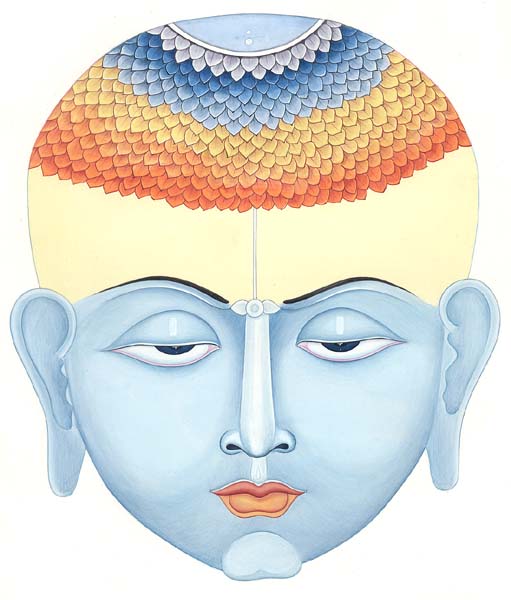
Modern depictions of some of the chakras, or yogic energy centers, said to be located in the head and down the spine. artist unknown. via
Saturday, April 21, 2007
Origami Mami
Maria E. Piñeres gallery
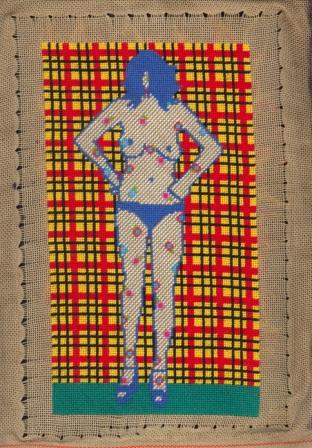
Origami Mami. 2004, cotton thread on canvas 12 1/2 x 9"
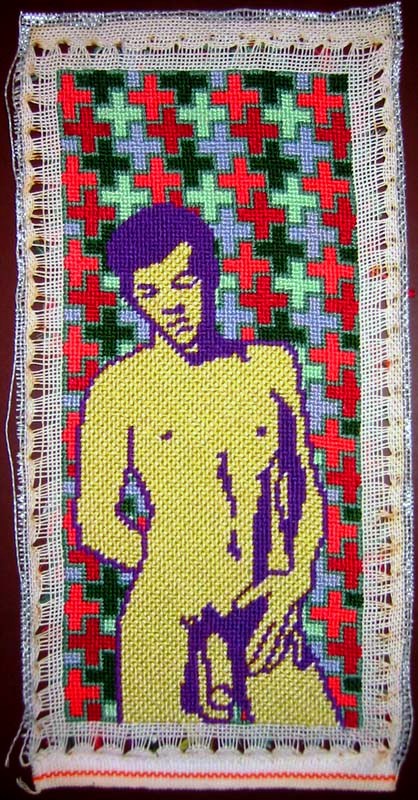
Red Crosses. 2004, cotton thread on canvas, 13 1/4 x 6 5/8"
Sixteenth-century Images of North America
woodcut illustrations by André Thevet, Royal Cosmographer of France in the second half of the sixteenth century.

In 1555 he accompanied Nicholas Durand, chevalier de Villegagnon, on the latter’s expedition to Brazil, but returned to France on the first available ship about ten weeks after his arrival. It is then, he wrote an account of his travels, Les Singularitez de la France antarctique (Paris, 1557).

Wittgenstein’s Colors
by Elaine Equi
.
Blond
Tamarind
Bacon
Fog
xxxxx xxxxx
Burlap
Winter Grass
Semi-dark
xxxxx xxxxx
Tarn
Goose
Nutmeg
xxxxx xxxxx
Brown Light
Hot Blue
xxxxx xxxxx
Lion’s Mane
Liverspot
Birch
xxxxxx via alecsoth
Friday, April 20, 2007
Voyage around my room
some suggestions for voyaging differently
is available online ).
In 1790 Xavier de Maistre was punished for having gotten into a duel by being put under house arrest for forty-two days. De Maistre took advantage of his sequestration, finding within his own four walls a wealth of material to dwell on. His short book, Voyage around my Room, recounts his expeditions during that time. It is a travel book like no other.
xWhich reminded me the book, À Rebours (translated into English as Against the Grain or Against Nature)by french novelist Joris-Karl Huysmans. The book tell the story of Des Esseintes- the last member of a powerful and noble family. He decides to leave Paris where he had lived an extremely decadent life which has left him disgusted with human society. And he absconds to a small house in the countryside in solitude.
He fills the house with his eclectic art collection. And decides to spend the rest of his life in intellectual and aesthetic contemplation. He indulge himself in intellectual experiments, and see his life only worth while by living an hyperaesthetic experience of the world.
on almost cloistral methods, to soothe his fantasy and to gratify his complex aesthetic sensations, his love of reading and contemplation. The finest pictures of Gustave Moreau hang on the walls, with the fantastic engravings of Luyken, and the strange visions of Odilon Redon. He has a tortoise curiously inlaid with precious stones; he delights in all those exotic plants which reveal Nature's most unnatural freaks; he is a sensitive amateur of perfumes, and considers that the pleasures of smell are equal to those of sight or sound; he possesses a row of little barrels of liqueurs so arranged that he can blend in infinite variety the contents of this instrument, his "mouth-organ" he calls it, and produce harmonies which seem to him comparable to those yielded by a musical orchestra.
In one of the book's more comic episodes, he spontaneously decides to visit London. When he reaches the train station, he overhears some English visitors, whom he finds disgusting. Feeling that he now knows what London would be like, he immediately returns home. x
also found
aleksandra domanovic video, aleksandra is humming while mapping her home in this videoThursday, April 19, 2007
Street Corner Sundials
stumbled on this German street corner sundials site, so, obviously i don't understand a word, i only take visual pleasure and share it with those who you who stop for a short visit
.
 .
.
 .
.
 .
.


algorithmic drawings
A family of algorithmic pen plotted drawings, each presented with the binary text for a Universal Turing Machine (UTM), were created for an exhibition in Manchester on the occasion of the Ninth International Symposium on Electronic Art (1998). .
The artistic procedure employs a form-generation method which, by analogy to biological process, may be viewed as epigenetic. The software (code), created by the artist, behaves as genotype capable of generating a distinctive “family of forms” within any given set of parameters. The hyperspace of all possible forms, based on the specific parameter settings for this Manchester edition, is infinitely vast. 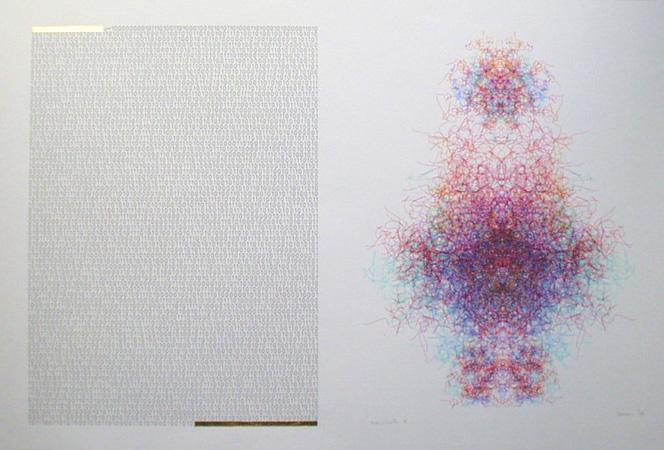
Manchester Illuminated Universal Turing Machine, #9 1998pen plotted drawing with gold leaf30" by 22" UTM - Is The gating logic for circuit boards in all general computers descends from a logical procedure known as a Universal Turing Machine (UTM). The logic for this algorithm by Alan Turing (1912-54) was written in 1936 and published in 1937 in the Proceedings of the London Mathematical Society. This paper, “On computable numbers, with an application to the Entscheidungsproblem", planted the seminal idea for all general computers.

Detail of the UTM binary text with gold leaf. Click here for full text page (719 kb).
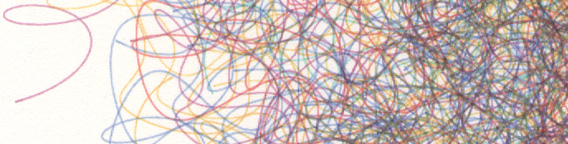
Detail shows algorithmically generated pen plotted lines from illumination #23 above
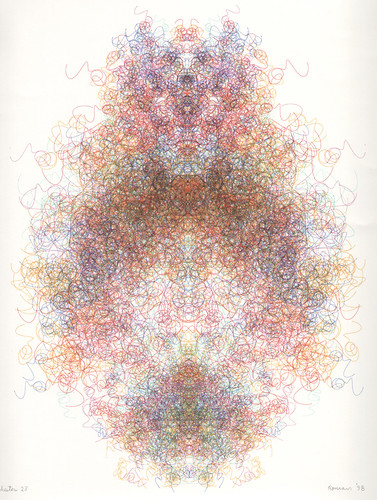
detail from one on the work of Illuminated Universal Turing Machine
Tiny Island
Photo by veloopity's flickr
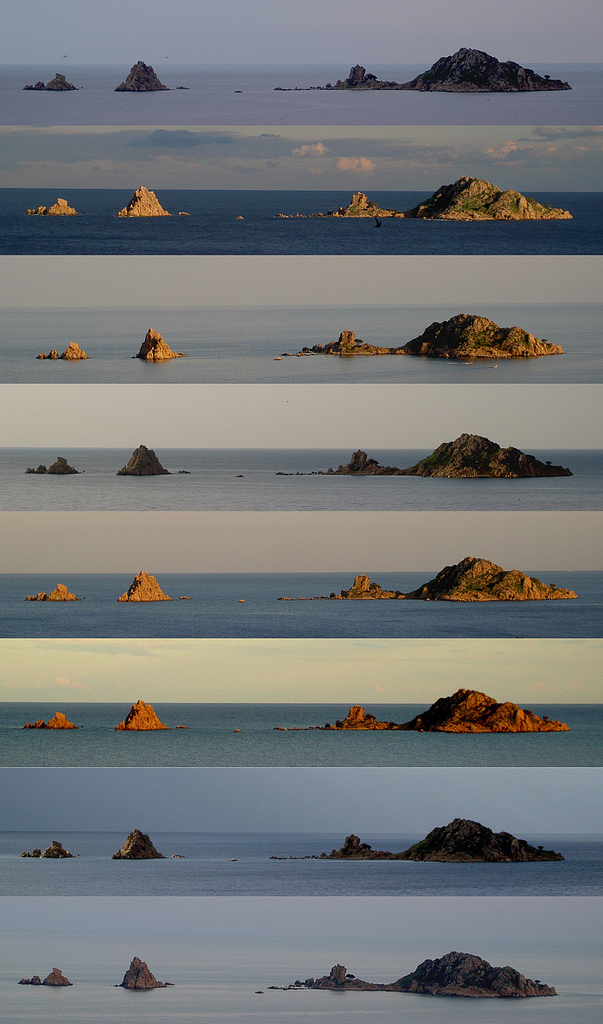
a group of tiny islands on the east coast of Sardinia, Italy. These images were taken at different times of the day during a week veloopity spent in Santa Maria Navarrese, seeing the islands from my balcony every day.
#
and via thingsmagazine: some Gorgeous Private Tropical Islands for Sale and private island sale, and here
Subscribe to:
Posts (Atom)


 Posts
Posts


